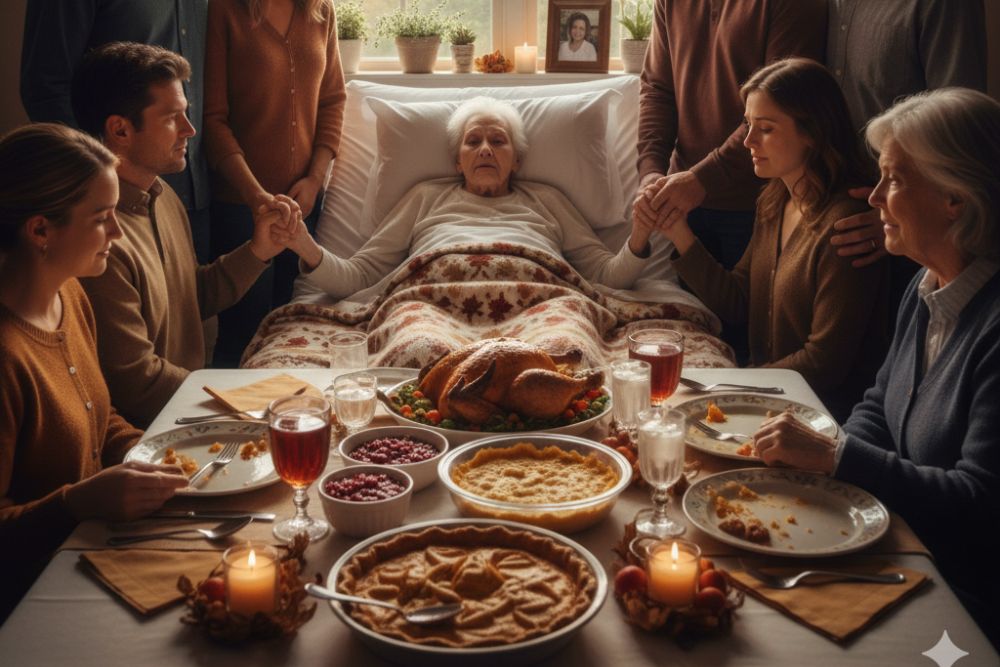
Thanksgiving at End of Life: Creating Meaningful Moments When Time Feels Precious
Thanksgiving during a terminal illness can still be meaningful. Families can create intimate celebrations focused on presence over perfection, gratitude over tradition, and connection over complexity. Small adjustments like shorter gatherings, simplified menus, and flexible participation honor both the holiday spirit and your loved one’s comfort while building lasting memories together.
When someone you love is facing a terminal illness, holidays take on a weight they’ve never carried before. Thanksgiving, with its emphasis on gathering, abundance, and gratitude, can feel both precious and unbearably heavy. You want to create meaningful moments. You want everything to feel normal. You want to make memories that will matter after they’re gone.
But you’re also exhausted. You’re managing medications and doctor appointments and insurance calls. You’re watching someone you love decline, trying to stay present while also preparing for a future without them. You’re fielding questions from family members who don’t understand the daily reality of caregiving. And now you’re supposed to orchestrate a holiday celebration?
The pressure to make this Thanksgiving “perfect”—especially if it might be the last one—can become crushing. Family members may have expectations about the traditional meal, the guest list, the timing. Meanwhile, you’re just trying to figure out if your loved one will have the energy to sit at the table for more than twenty minutes, whether they can still swallow solid food safely, and how to keep them comfortable when their pain medication schedule doesn’t align with dinner time.
Here’s what I want you to know before we go any further: Thanksgiving doesn’t have to look like it used to. In fact, the most meaningful celebrations often happen when families release traditional expectations and focus on what truly matters: connection, comfort, and gratitude for the time you still have.
This isn’t about settling for less. It’s about discovering what actually creates meaning when time is precious and energy is limited. It’s about building a holiday that honors your loved one’s comfort and capacity rather than Instagram-worthy ideals. It’s about giving yourself permission to do things differently—not as failure, but as fierce love in action.
Let me show you how.

Why This Holiday Still Matters (Maybe More Than Ever)
Before we talk about the practical adjustments, let’s acknowledge something important: You might be wondering if celebrating at all makes sense. Why go through the effort when everyone is exhausted and emotional? Wouldn’t it be easier to just skip it this year?
I understand that impulse. But here’s what research from the National Institute on Aging and decades of palliative care practice consistently show: Maintaining meaningful rituals during serious illness improves wellbeing for both patients and caregivers. Not the performance of rituals—not checking boxes or meeting obligations—but the human connection and sense of continuity that authentic celebrations provide.
Holidays serve as emotional anchors during uncertain times. They mark time in meaningful ways beyond medical appointments and treatment schedules. They create opportunities for the kinds of conversations and connections that families later identify as sacred—not because they were perfect, but because they were real.
What Families Tell Us Actually Matters
When I ask families what made their last holiday together meaningful, no one mentions the perfectly cooked turkey or the elaborate decorations. They talk about:
Being together, even if briefly. The fact of gathering matters more than the duration. Twenty meaningful minutes can outweigh five forced hours.
Honoring the person’s comfort and energy levels. When celebrations adapt to capacity rather than demanding someone rise to tradition, everyone relaxes. The person who’s ill doesn’t feel like a burden. Caregivers stop performing and can actually be present.
Creating space for both joy and grief. When families give each other permission to feel multiple things at once—gratitude and sorrow, celebration and mourning, laughter and tears—the pressure to pretend dissolves. Authentic emotion becomes possible.
Capturing memories through photos, stories, or recordings. Not for social media, but for keeping. These tangible pieces of connection become treasured after loss.
Allowing imperfection without guilt. The burnt rolls, the simplified menu, the gathering that ends earlier than planned, the moment someone has to leave the table—none of it matters when you’re focused on presence rather than performance.
Thanksgiving provides a culturally accepted framework for expressing gratitude, something that becomes profoundly important when time feels limited. The holiday gives you permission to say the things that might feel too heavy or too obvious on an ordinary day. It creates space for acknowledgment and appreciation that daily life often rushes past.
But—and this is crucial—that meaning only emerges when the celebration actually fits your current reality rather than demanding you squeeze into a tradition that no longer serves you. Which means you need permission to change things. So let’s talk about that explicitly.
The Permission to Do It Differently: What You Need to Hear
Before we get into practical adaptations, we need to address the guilt and resistance many families feel about changing holiday traditions. You might be worried about disappointing your loved one, letting down other family members, or somehow failing to honor the holiday properly.
So hear this clearly: Adapting your celebration isn’t giving up on Thanksgiving. It’s honoring what Thanksgiving is actually about—gratitude, togetherness, and nourishment—in a way that’s sustainable and meaningful for your current circumstances.
The traditional Thanksgiving our culture celebrates—the huge meal, the all-day gathering, the house full of people—is a relatively modern construction anyway. It’s not sacred. It’s not the only valid way to express gratitude or mark the holiday. And it’s certainly not worth sacrificing your loved one’s comfort or your own wellbeing to maintain.
Why Permission Matters
Many families sabotage their own holidays by trying to maintain traditions that no longer fit, driven by unexamined assumptions about what “should” happen. Adult children feel obligated to host the meal they’ve always hosted, even though they’re now also providing 24-hour care. Extended family members insist on the full gathering “because that’s what Mom would want,” without considering that Mom is now exhausted by noise and crowds.
This pressure comes from:
- Fear that changing traditions means accepting decline. If we can just do Thanksgiving the normal way, maybe things aren’t as bad as they seem.
- Worry about disappointing the person who’s ill. They love our big Thanksgivings; won’t they be sad if we change it?
- Desire to create one last “normal” holiday. If this might be our last Thanksgiving together, shouldn’t it be like all the others?
- Guilt about reducing the holiday. Am I being selfish by wanting something simpler? Am I not trying hard enough?
But here’s the truth these concerns miss: Your loved one doesn’t need the performance of normalcy. They need your presence. They need comfort. They need to feel like themselves rather than a burden around which everyone is performing.
And you? You need sustainability. You need space to actually experience the holiday rather than surviving its execution. You need permission to make choices that honor both your love and your limitations.
So here it is, explicitly: You are allowed to make Thanksgiving different this year. You are allowed to simplify, abbreviate, and adapt. You are allowed to prioritize comfort over tradition, presence over perfection, and connection over complexity.
Now let’s talk about what that actually looks like.
Reimagining Your Thanksgiving: Practical Adaptations That Honor Everyone
Traditional Thanksgiving can be exhausting even for healthy people—the marathon cooking, the complex timing, the hours of hosting and socializing. When someone is seriously ill, those standard expectations need thoughtful adjustment. But adjustment doesn’t mean sacrifice. It means intentionality.
Let’s walk through the major elements of Thanksgiving and explore how to adapt each one in ways that actually improve the day for everyone involved.
The Meal: Releasing the Burden of the Feast
The elaborate Thanksgiving feast has become the holiday’s centerpiece, but here’s a secret: the meal is the least important part. It’s not why people remember the holiday as meaningful. In fact, the stress of producing it often prevents the cook from actually enjoying the gathering.
This year, consider separating food from love. They’re not the same thing. You can nourish your family without exhausting yourself.
Practical alternatives to the traditional marathon cooking session:
Order prepared foods or a complete meal. Many grocery stores, restaurants, and catering services offer Thanksgiving meals that rival or exceed home cooking. Some deliver. Some let you pick up the day before. This isn’t cheating or failing. It’s choosing to spend your energy on presence rather than performance.
Make it a true potluck with specific assignments. Not the vague “bring a side dish if you want,” but explicit requests: “Sarah, can you bring the sweet potatoes?” “Mike, can you handle the green bean casserole?” Specific assignments mean people know what’s needed and you’re not duplicating effort or left scrambling.
Simplify the menu dramatically. Who decided Thanksgiving requires twelve dishes? Choose three or four favorites rather than attempting the full spread. Your loved one probably isn’t eating much anyway. The abundance doesn’t matter to them—your company does.
Consider favorite foods over traditional items. If your mom always loved lasagna but has no attachment to turkey, make lasagna. Tradition serves people, not the other way around. If comfort food means grilled cheese and tomato soup, that’s a perfect Thanksgiving meal.
Adjust timing to energy patterns. Most families default to early evening dinner because that’s traditional. But if your loved one has better energy at 2:00 pm, have Thanksgiving lunch instead. Don’t sacrifice their comfort and participation for convention.
Set up buffet or family-style service. This allows flexible timing. People can eat when hungry rather than waiting for a synchronized meal service that requires everyone to gather simultaneously. Someone can help your loved one get a plate when they’re ready without stopping everything.
Prepare individual portions for your loved one. Separate their food into manageable amounts, pre-cut if needed, arranged appealingly on a smaller plate. This respects their capacity without making their limitations the center of attention.
The meal is a vehicle for gathering, not the point of gathering. Once you internalize that, the pressure evaporates and creativity becomes possible.
Flexible Participation: Honoring Energy That Fluctuates
Your loved one’s energy and comfort can vary significantly throughout a day, sometimes hour by hour. Building flexibility into the gathering honors that reality rather than demanding they rise to meet rigid expectations.
Create options for varying levels of participation:
Position their recliner, wheelchair, or even hospital bed in the gathering space. Bring the party to them rather than expecting them to come to the party. Arrange furniture so they’re included in the circle of conversation rather than isolated at the edges. They can participate from comfort.
Designate a quiet room for rest. Make it clear that leaving the gathering to rest isn’t rejection or failure—it’s taking care of oneself. Set up a comfortable space with a monitor or phone nearby so they can rejoin easily if they want to.
Record conversations or video key moments. If they need to rest during parts of the gathering, recording means they can listen or watch later. This reduces the pressure to stay present through exhaustion and preserves moments they might otherwise miss.
Shorten the overall gathering window. Instead of an all-day affair, consider a focused two or three-hour gathering. This respects everyone’s capacity—both your loved one’s limited energy and your own exhaustion from caregiving. It’s okay for Thanksgiving to be shorter this year. Compressed doesn’t mean diminished.
Build in permission to come and go. Your loved one should feel free to participate when they want and withdraw when they need to, without explaining or apologizing. Explicitly saying “Please come and go as you need to—we’re just glad you’re here” at the start removes that burden.
Have a backup caregiver ready. If you’re hosting, arrange for another family member or hired caregiver to be “on duty” for your loved one so you can actually participate in the gathering yourself. You deserve to experience Thanksgiving too, not just orchestrate it.
Flexibility isn’t accommodation of weakness. It’s recognition of reality. When you build a gathering around people’s actual capacity rather than demanding they meet an arbitrary standard, everyone relaxes and genuine presence becomes possible.
The Guest List: When Intimacy Serves Better Than Tradition
Larger gatherings can be overstimulating, exhausting, and chaotic when someone is seriously ill. Noise levels rise. Conversations multiply. The cognitive and sensory load increases. What once felt festive can now feel overwhelming.
This year, intimacy might serve everyone better than the traditional big gathering. But that conversation can be fraught with hurt feelings and misunderstanding if not handled carefully.
Questions to guide your guest list decisions:
Who does your loved one most want to see? Have an honest conversation with them about who matters most to them right now. Their answer might surprise you. Sometimes it’s the grandchildren. Sometimes it’s one particular friend or family member. Honoring their preference matters more than family hierarchy.
Can you host some family members on different days? Consider spreading Thanksgiving week rather than concentrating everyone on Thursday. Different groups visiting over several days reduces overwhelm while still including everyone. An intimate Thursday with immediate family and a Friday with extended relatives might work better than cramming everyone together.
Would a smaller gathering feel more manageable? Be honest about your own capacity too. You’re the one managing this. If a big gathering will exhaust you to the point where you can’t be present, scale it down. You’re allowed to make this choice.
How do you communicate changes without hurt feelings? Be direct and compassionate: “This year we’re doing a smaller Thanksgiving to honor Mom’s energy levels and give us all a chance to really be together rather than managing a big event. We’d love to see you on Friday instead if that works. This isn’t about excluding anyone—it’s about making it possible for Mom to actually enjoy the day.”
Most people will understand when you frame it around your loved one’s comfort. Those who don’t understand are revealing their own needs matter more to them than your loved one’s wellbeing—useful information.
The goal is connection, not attendance numbers. Five people truly present can create more meaning than twenty people performing presence.
Now that we’ve addressed the practical elements of the gathering itself, we need to talk about something potentially more challenging: the family dynamics and emotions that surface when serious illness meets holiday expectations.

Managing Family Expectations and Emotions: The Conversations You Need to Have
Holidays amplify family dynamics. Add terminal illness to the mix, and those dynamics can become explosive. Different family members process serious illness differently. Some want to pretend everything is normal. Others struggle to be present because grief feels too close. Still others want to talk openly about the situation while some find that unbearable.
These differences create tension that can sabotage the holiday if not addressed proactively. The key is explicit communication ahead of time rather than hoping everyone will instinctively understand what’s needed.
Common Family Tensions and How to Navigate Them
The “everything is fine” contingent vs. the “we need to talk about it” contingent.
Some family members cope by maintaining normalcy and avoiding difficult topics. Others need to process grief openly and explicitly. Neither approach is wrong, but when they collide at Thanksgiving, conflict erupts.
Navigation strategy: Have separate conversations ahead of time with different family members, acknowledging their different needs while establishing some ground rules for the gathering itself. “I know some of us cope by staying focused on the positive, and others need to talk through their feelings. Both are valid. On Thanksgiving, let’s try to follow Mom’s lead—if she wants to talk about her illness, we’ll listen. If she wants to focus on other things, we’ll respect that. And let’s agree that if someone needs to step out to process emotions, that’s okay too.”
The advice-givers who weren’t there for the daily caregiving.
Extended family members who haven’t been present for the day-to-day reality often arrive at holidays with strong opinions about treatment decisions, care choices, or how things should be done. This can feel infuriating to primary caregivers who’ve been making difficult decisions alone.
Navigation strategy: Set boundaries clearly and early. “I appreciate that you care. The decisions we’ve made have been thoughtful and in consultation with Mom’s medical team. If you’d like to be more involved in her care going forward, we can talk about what that would look like. But right now, I need support rather than second-guessing.”
The children who don’t understand why things are different.
Kids sense tension and change even when adults try to hide it. Excluding them from age-appropriate truth creates confusion and anxiety. But overwhelming them with adult emotions is inappropriate too.
Navigation strategy: Talk to children ahead of time, matched to their developmental level. Acknowledge that things are different. Give them age-appropriate information. Let them know it’s okay to feel multiple things at once. And provide them with concrete ways they can help or participate that give them some sense of agency.
Communication Strategies That Actually Help
Set expectations in advance through a family call, email, or group text. Don’t wait until everyone arrives on Thanksgiving to explain that things will be different. Give people time to adjust their own expectations. Share logistics clearly: timing, location, what to bring, what kind of gathering to expect.
Name the reality without shame or apology. “This Thanksgiving will be different, and that’s okay. We’re focusing on Dad’s comfort and on being together in whatever way works for him. The meal will be simpler. The day will be shorter. And we may need to be flexible if Dad’s having a hard day. This isn’t anyone’s fault—it’s just where we are.”
Give people permission to feel multiple things at once. “It’s okay to feel sad and grateful at the same time. It’s normal to feel grief even while we’re celebrating. We don’t have to pretend to be okay all the time.”
Identify a point person to answer logistics questions. One person fields questions about timing, menu, what to bring, etc. This prevents the primary caregiver from being bombarded with requests while trying to manage everything else.
Create space for both lighthearted moments and honest emotion. Plan for both. Maybe start with lighter conversations and leave space later for anyone who wants to share appreciation or memories. Don’t force emotional moments, but don’t avoid them either.
Talking With Children: Making It Age-Appropriate
Children need truth, but truth matched to their capacity. Here are some scripts that work:
For younger children (ages 3-7): “Grandpa is very sick, so we’re having a smaller, quieter Thanksgiving this year. We’ll still have yummy food and be together, but Grandpa might need to rest sometimes. That’s okay, and we can still tell him we love him. What are you thankful for this year?”
This acknowledges the change without overwhelming them. It gives them concrete information about what to expect. And it includes them in the gratitude focus of the day.
For older children and teens (ages 8+): “You might have noticed that things feel different this year. Grandma’s illness means we’re celebrating Thanksgiving in a smaller way, and this might be our last Thanksgiving together. It’s okay to feel sad and happy at the same time. We want you to be part of creating special memories. What matters most to you about spending time with Grandma right now?”
This respects their awareness and emotional capacity. It invites them to participate in creating meaning rather than just being subject to adult decisions. It validates complex emotions.
With family dynamics addressed, let’s turn to something that can transform the holiday from obligation into sacred moment: creating new rituals that honor your current reality.
Creating New Rituals of Gratitude and Legacy: What Makes This Thanksgiving Sacred
Thanksgiving naturally invites reflection on what we’re grateful for. This year, that reflection takes on profound weight when time is precious and loss is approaching. Rather than fighting that reality, you can work with it by creating rituals that capture legacy, honor connection, and build lasting memory.
These aren’t activities to check off a list. They’re invitations to slow down and be present in ways that matter.
The Gratitude Circle With a Twist
Instead of the typical “what are you thankful for?” round where everyone dutifully mentions health, family, and abundance, try a more specific invitation that creates real connection:
Invite each person to share one specific memory with your loved one or one way they’ve been impacted by them.
This shifts from abstract gratitude to concrete appreciation. It creates a living legacy. It allows your loved one to hear how they’ve mattered while they’re still present to receive it.
Examples of what this looks like:
- “I’m grateful for the way Dad taught me to change a tire when I was sixteen. He was so patient, and now every time I check my tire pressure, I think of that afternoon.”
- “I remember when Mom stayed up all night helping me finish my science project. She didn’t even know anything about volcanoes, but she just sat with me and helped me figure it out. That’s who she’s always been.”
- “I love that Uncle Jim always makes terrible puns and laughs at his own jokes. He taught me not to take myself too seriously.”
These specific memories do something abstract gratitude statements cannot: they show your loved one exactly how they’ve shaped the people they love. They create a record of impact. They offer comfort in the specificity—not just “you matter” but “here is exactly how you matter.”
Your loved one might cry. You might cry. That’s okay. That’s not ruining Thanksgiving—that’s Thanksgiving becoming real.
Memory Jar or Legacy Letters
Set up a station with nice paper, pens, and a beautiful jar or box. Throughout the gathering, invite people to write down:
- A favorite memory
- A funny story they don’t want to forget
- Something they want your loved one to know
- A way your loved one influenced them
- A quality they admire
These can be read aloud that day, saved for your loved one to read later, or compiled into a keepsake book. After they’re gone, these specific, handwritten pieces of love become treasured beyond measure.
This activity gives people something concrete to do with their emotions. Some people process by talking; others need to write. This accommodates both.
Photo Scanning and Storytelling
Pull out old photo albums—the physical ones, if you still have them, or digital collections if that’s what you have. Take turns asking your loved one about the stories behind the pictures. Who was that person? Where was this taken? What happened that day?
Record these conversations. Audio or video, whatever’s available. Your loved one’s voice telling these stories becomes a gift after they’re gone. The details they remember, the way they tell the story, the asides and tangents—all of it becomes precious.
This activity honors their memory while it still works. It engages them in something they can often still do well even as other cognitive functions decline. It creates connection across generations as children and grandchildren learn family history.
A Blessing or Acknowledgment Moment
Whether your family is religious or secular, a brief moment of acknowledgment about the preciousness of being together can bring meaningful closure to the gathering.
Example of a secular version: “We’re grateful to be together today. We honor the love in this room, the memories we carry, and the time we still have. May we hold each other with tenderness and grace.”
Example of a spiritual version: “We give thanks for this gathering, for the food before us, for the love that surrounds us, and for [name]’s presence with us today. We ask for strength for the journey ahead and for the grace to cherish each moment.”
This doesn’t have to be elaborate. A simple acknowledgment that this gathering is sacred—not despite the shadow of illness but because of it—can shift the entire tone of the day.
These rituals aren’t meant to be performed. They’re invitations to slow down and be present in ways that matter. Choose the ones that resonate with your family’s style and skip the rest. The goal is meaning, not completion.
Now let’s talk about the practical side: what do you actually need to do to pull this off?
Practical Thanksgiving Planning Checklist for Families
Planning ahead reduces day-of stress and creates space for the presence we’ve been talking about. Here’s a timeline that works:
Two Weeks Before Thanksgiving
Have the conversation with your loved one. Ask what they want and realistically can manage. Their input matters, even if you ultimately need to adapt their wishes to reality. Knowing what matters to them guides all other decisions.
Make firm decisions about date, time, location, and guest list. Commit to these rather than leaving them fuzzy. “We’ll figure it out” creates ongoing stress.
Communicate plans clearly with family members. Share specifics about timing, what to bring, what kind of gathering to expect, and any ways they can help. Be explicit about what you need.
Order or plan your simplified meal. If ordering, place the order with pickup/delivery details confirmed. If cooking, create your streamlined menu and shopping list.
Arrange for any medical equipment or comfort items. Hospital bed? Extra wheelchair? Oxygen concentrator? Arrange these now, not the day before.
One Week Before Thanksgiving
Confirm RSVPs and dietary needs. Pin down exact numbers. Find out about dietary restrictions or allergies so you can plan appropriately.
Prep the home for accessibility. Clear pathways for walkers or wheelchairs. Arrange extra seating that’s stable and easy to get in and out of. Set up the space with your loved one’s comfort as priority.
Stock comfort supplies. Extra pain medication, tissues, blankets, whatever provides comfort. You don’t want to be running to the pharmacy on Thanksgiving.
Set up recording devices if you’re capturing stories. Test them. Charge batteries. Figure out how they work so you’re not fumbling with technology during the gathering.
Create a backup plan for reduced participation. What happens if your loved one is having a particularly hard day? How will you adapt? Thinking through scenarios now reduces panic if they happen.
The Day Before Thanksgiving
Prepare as much food as possible in advance. Anything that can be made ahead should be. This leaves Thanksgiving day for presence, not performance.
Set up the gathering space with comfort in mind. Arrange furniture. Test lighting. Make sure temperature is comfortable. Set up the memory jar station or photo albums if you’re using those rituals.
Charge cameras, phones, and recording devices. Ensure you have the tools ready to capture what matters.
Review medication schedule with your care team. Know when medications are due and plan around them rather than trying to force them around the gathering schedule.
Get adequate rest yourself. You need your own reserves. Don’t stay up until midnight cooking. The meal is less important than your presence.
Thanksgiving Day
Allow extra time for personal care and comfort setup. Don’t rush. Start the day with margin rather than frantic catching up.
Begin the gathering when energy is highest. If that’s 2:00 pm, start at 2:00 pm. Traditional timing doesn’t matter.
Designate someone to monitor comfort and needs. One person has eyes on your loved one—temperature, pain level, fatigue, agitation. This person isn’t hosting; they’re attending.
Take photos and capture moments, but don’t let documentation replace presence. A few good photos beat hundreds of mediocre ones. Put the camera down and be there.
Give yourself permission for imperfection. The burnt rolls, the missed moment, the thing you forgot—none of it actually matters. Breathe.
After Thanksgiving
Send brief thank-you messages to attendees. Not elaborate notes—simple acknowledgment of their presence and any specific help they provided.
Organize photos and recordings while details are fresh. Transfer files. Name them meaningfully. Back them up. Do this within a few days while you remember what each one captures.
Write down stories you don’t want to forget. Funny moments, sweet exchanges, something meaningful your loved one said. Memory fades faster than we realize. Capture it now.
Check in with your loved one about their experience. What did they enjoy? What was hard? What would they want different if there’s another holiday? Their feedback guides future planning.
Rest and process your own emotions. You’ll be exhausted—physically and emotionally. That’s normal. Give yourself permission to collapse for a bit. Process the joy and grief the day stirred up.
With the practical planning covered, let’s address what might be the most challenging emotional territory: how to hold both gratitude and grief at the same time.
When Grief Meets Gratitude: Holding Both at Once
Thanksgiving during terminal illness is bittersweet in ways that might feel overwhelming. You’re grateful for the time you have while simultaneously grieving the time you won’t get. You feel joy at being together while carrying the ache of approaching loss. You want to be fully present but part of you is already mourning.
These contradictory emotions aren’t a problem to solve. They’re the natural human response to love in the face of loss. The question isn’t how to eliminate the tension—it’s how to hold both feelings without letting either one consume you.
This emotional territory is what therapists call anticipatory grief—the mourning that begins while your loved one is still alive. It’s grief for what you’re losing in real time: the person they used to be, the future you imagined together, the relationship as it once existed. It’s also grief for what’s coming: their death, your life after, the hole their absence will leave.
What Anticipatory Grief Looks Like During Holidays
During Thanksgiving, anticipatory grief might show up as:
Crying while also feeling grateful to be together. You’re aware this might be the last Thanksgiving, and that awareness brings tears even in moments of genuine joy. Both the gratitude and the grief are real.
Difficulty being fully present because of worry about the future. Part of your mind is already at next Thanksgiving when they won’t be here, making it hard to stay in this Thanksgiving while you have it.
Feeling guilty for enjoying moments. “How can I laugh at Uncle Mike’s story when Mom is dying?” The guilt arrives whenever joy surfaces, as if happiness betrays the seriousness of the situation.
Noticing changes in your loved one that others don’t see. You’re with them daily. You see the decline in ways holiday visitors might miss. Their lack of awareness of how much has changed can feel invalidating or exhausting.
Wanting the day to last forever and also wanting it to be over. The emotional intensity is both precious and unbearable. You want to freeze these moments and also escape the weight of them.
All of these responses are normal. They don’t mean you’re doing it wrong. They mean you love deeply and loss is approaching.
How to Honor Both Grief and Gratitude Without Compartmentalizing
Rather than trying to suppress sadness or force happiness, allow the full emotional range. This isn’t about “keeping it together” or “staying positive.” It’s about being honest with yourself and each other about the complex reality you’re living.
Permission statements that help when grief and gratitude collide:
“It’s okay to feel multiple things at once. I don’t have to choose between grateful and sad. Both are true.”
This releases the pressure to perform a single acceptable emotion. You can be both devastated and thankful simultaneously.
“I can be grateful for today and terrified about tomorrow. Neither feeling cancels out the other.”
The future doesn’t have to disappear from awareness for you to appreciate the present. Acknowledging what’s coming doesn’t ruin what’s here.
“My grief is evidence of my love. The depth of my sorrow reflects the depth of my connection.”
Grief isn’t the enemy. It’s the price of love. When you understand grief as love in another form, it becomes less frightening.
“I don’t have to be strong all the time. It’s okay to fall apart and then gather myself back together.”
Strength isn’t the absence of breakdown. It’s the cycle of falling apart and recovering, again and again.
“Moments of joy don’t betray my sorrow. Laughter doesn’t mean I’ve forgotten the weight of this.”
You’re allowed to laugh. You’re allowed to enjoy the meal, the conversation, the moment. That doesn’t diminish your awareness of what’s happening. It honors it by refusing to let approaching loss steal every remaining moment.
When Family Members Are at Different Places in Grief
Not everyone grieves on the same timeline or in the same way. Some family members might be ready to cry and talk openly about loss. Others might desperately need to maintain normalcy and avoid the heavy topics. These differences can create friction if left unaddressed.
The key is explicit permission for different styles:
“Some of us need to talk about our feelings. Others need to focus on lighter things. Both ways are okay. Let’s try to respect each person’s process while also making space for the range of emotions in the room.”
This prevents anyone from being shamed for their grief style while acknowledging that everyone’s navigating the same situation differently.
Practical strategies for managing varied grief responses:
Create different spaces within the gathering. The kitchen might be where people are keeping things light and normal. The back porch might be where those who need to cry can step away. The living room holds both. Having physical options helps people regulate without having to explain or justify.
Check in privately with people who seem to be struggling. A quiet “Are you okay? Do you need anything?” can help someone who’s overwhelmed but trying to hold it together. They might just need permission to step out.
Model honest emotion yourself. If you cry, say “I’m crying because I’m so grateful we’re all here together and so sad knowing time is limited. Both of those feelings are true.” This gives others permission to be complex too.
Don’t force emotional moments, but don’t avoid them either. If someone starts sharing deep appreciation or crying, let it happen. Don’t rush to fix it or move past it. Sit with it. That’s often where the meaning emerges.
Thanksgiving during terminal illness won’t feel like other Thanksgivings. That’s not failure. That’s honesty. The meaning comes not from pretending everything is fine, but from being present to what actually is—the love, the loss, the gratitude.